
Dalaman Kalynda Ancient City
This is an indication of Dalaman's historical importance.
When Dalaman is mentioned, clear bays, lush nature, the Dalaman River , and the outdoor activities the region offers usually come to mind. However, Dalaman's assets are not limited to natural beauty. The district also holds significant cultural traces dating back thousands of years. One of the most striking examples of these traces is the ancient city of Kalynda, located near the Şerefler neighborhood.
The ruins found on and around Asar Tepe , which overlooks the Dalaman Plain, are now associated with Kalynda. The settlement is located approximately 3 kilometers east of the Dalaman district center. Archaeological research in the area has revealed remnants of city walls, building foundations, and tombs that are believed to date back to the Archaic Period.
What makes Kalynda special is not only its ancient history. Located in southwestern Anatolia, at a point where the Carian and Lycian cultures converged, the city has historically been a crossroads of diverse political and cultural influences.
An Ancient Settlement Between Caria and Lycia
The question of which ancient region Kalynda should be considered to belong to has been addressed differently in various sources throughout history. Some ancient sources associate the city with Caria, while others place it within Lycia. Today, Kalynda is generally considered one of the important settlements in the Caria-Lycia border region.
This situation is actually quite important for understanding the historical geography of Dalaman. The region was not merely an area situated between two ancient geographical regions; it was a bustling transit zone where different communities, trade routes, and political powers met for centuries.
Kalynda's high location is no coincidence. Establishing the settlement on a commanding hill overlooking the Dalaman Plain offered a strategic advantage, allowing for control of the surrounding area. Looking at the region today, this geographical choice is even more clearly understood.
The name Kalynda has survived from thousands of years ago to the present day.
One of the most notable ancient authors providing information about Kalynda is Herodotus. Thanks to ancient historical records, it is known that Kalynda was a city that existed in the region in the 5th century BC.
One of the most interesting events in the city's history is connected to the Battle of Salamis, which took place in 480 BC. According to Herodotus, Kalynda joined the fleet of the Persian King Xerxes with one ship. The city's ruler, Damasithymos, commanded the Kalynda ship. The collision between the Kalynda ship and the ship commanded by Queen Artemisia of Caria during the battle is one of the remarkable events that ensured the name of Kalynda survived in ancient historical accounts to this day.
The fact that a small Anatolian city is still associated with one of the world's best-known ancient naval battles, even after nearly 2,500 years, makes Kalynda's place in history even more interesting.
Kalynda, Kaunos, Rhodes and the Mediterranean World
Kalynda's history is not limited to the Persian Wars. In the following centuries, the city maintained continuous relations with the powerful centers in its surroundings.
Documents from the Hellenistic period indicate economic and administrative relations between Kalynda and the Ptolemaic administration. In particular, the archives of Zeno contain information regarding connections between Kalynda, Kaunos, and the Ptolemaic administration in Egypt. These same documents also mention an annual festival held in a place called Kipranda within Kalynda's territory. It is believed that this festival may have been held in honor of Artemis, one of the city's important goddesses.
In later periods, the city established political relations with Kaunos, Rhodes, and the Lycian world. Ancient sources indicate that Kalynda attempted to secede from Kaunos's rule in the 2nd century BC and was placed under Rhodian administration by the Roman Senate. In the 1st century AD, it appears that the city was connected to the Lycian League.
All these developments reveal that Kalynda is not a small, isolated settlement cut off from the outside world; it is a city affected by political and economic developments in the Eastern Mediterranean.
Kalynda had her own coins.
One of the most valuable archaeological pieces of evidence revealing the political and economic identity of an ancient city is its coins. Kalynda is among the ancient settlements that minted their own coins.
Examples of coins from Kalynda featuring symbols such as the head of Zeus, eagles, and lightning are known. Information about the city published by Dalaman Municipality also states that the people of Kalynda minted coins and that these coins depict Zeus and eagles.
The fact that scientific studies on Kalynda coins were published in 2025 shows that research on the city continues to generate new data.
What remains of Kalynda today?
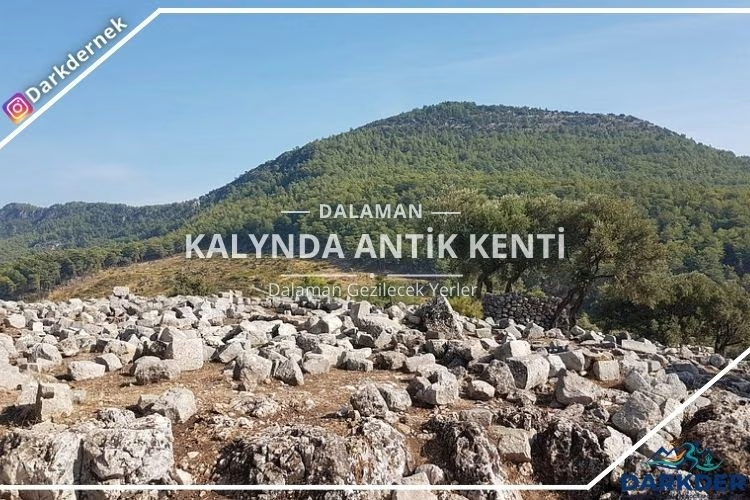
Kalynda is not an ancient city with grand structures remaining intact like Ephesus or Aphrodisias. In a significant part of the region, traces of the past are found scattered throughout the landscape, intertwined with vegetation.
Excavations at Asar Tepe have revealed remnants of fortification systems, towers, various building foundations, and tombs. Historical studies also mention the walls surrounding the hill and some tower structures.
This doesn't diminish Kalynda's value. On the contrary, one of the features that makes it unique is that traces of the past can still be read within Dalaman's natural landscape.
Instead of expecting a classic archaeological site with massive columns or grand theaters when visiting Kalynda, you should consider that the land you are standing on is part of a city that was inhabited by people approximately two thousand five hundred years ago.
Archaeological Excavations in Kalynda
Between 2022 and 2024, rescue excavations were carried out at Asar Tepe in Şerefler neighborhood under the direction of the Fethiye Museum Directorate. Archaeologists, epigraphists, and experts from various universities participated in the studies. Scientific publications were prepared on the findings unearthed as a result of the excavations, covering various topics such as coins, ceramics, amphora seals, lamps, and inscription fragments.
Here's an important scientific detail: while it's generally accepted that the ruins at Asar Tepe belong to Kalynda, no definitive evidence directly proving the city's name has yet been found. Therefore, the precise location of Kalynda remains a subject of ongoing research in the archaeological world.
This uncertainty makes Kalynda's story even more intriguing, because archaeology is not just about showcasing what is known, but also about uncovering the unknown using scientific methods.
A place where nature and history meet.
Kalynda holds a special significance for an association like DARKDER, which focuses on nature, movement, and active living.
Located amidst the pine forests, hills, and natural hiking trails of Dalaman, this historical region is one of those places where nature walks and cultural exploration can meet on the same route. Walking along a path, you can not only admire the scenery but also follow the traces of thousands of years of history, making the region quite special.
However, conservation awareness should always be prioritized in nature activities carried out at archaeological sites. Historical stones should not be moved, ceramic or similar fragments visible on the surface should not be taken, unauthorized entry into excavation areas should be avoided, and no waste should be left behind. The way to truly discover an ancient site is not by taking a piece of it, but by preserving it in its original location for future generations.
Rediscovering Dalaman's Past
The ancient city of Kalynda represents a very important cultural heritage of Dalaman, often overshadowed by its sea and nature. Today, the few stone walls, foundations, or tomb remains seen while walking on the hills overlooking the Dalaman Plain may seem silent at first glance. However, a remarkably dynamic history unfolded on these same lands, spanning from Persian campaigns to Hellenistic kingdoms, from Kaunos to Rhodes, and to the Lycian world.
Perhaps the most impressive aspect of Kalynda lies precisely here.
We can walk again today on the hills where life flourished thousands of years ago, and look down upon the Dalaman Plain from the same landscape. People, states, and cities change; but mountains, plains, and roads continue to connect the past with the present. Kalynda is not just an ancient city remaining from Dalaman's past; it is a silent legacy reminding us of the deep memory of the geography we live in. On every route we take into nature, we don't just discover new places. Sometimes, we rediscover the story of the land we walk on.